
I am not a fully trained farrier — but I have been trimming a variety of horses for the past 13 years. And hoof care is a topic that comes up often with clients. First, many people come to me because their horses are having trouble being handled by the farrier. On more than a couple occasions, the farrier has refused to return until the horse’s behavior improves. Additionally, a lot of my students struggle to find a competent farrier to trim their horses. And some don’t even realize how poorly their horses feet are being trimmed. As such, I do try to teach my students the basics of hoof anatomy, angles, and trimming. And help them prepare their horses as much as possible to be good citizens for the farrier.
Knowing what looks right.

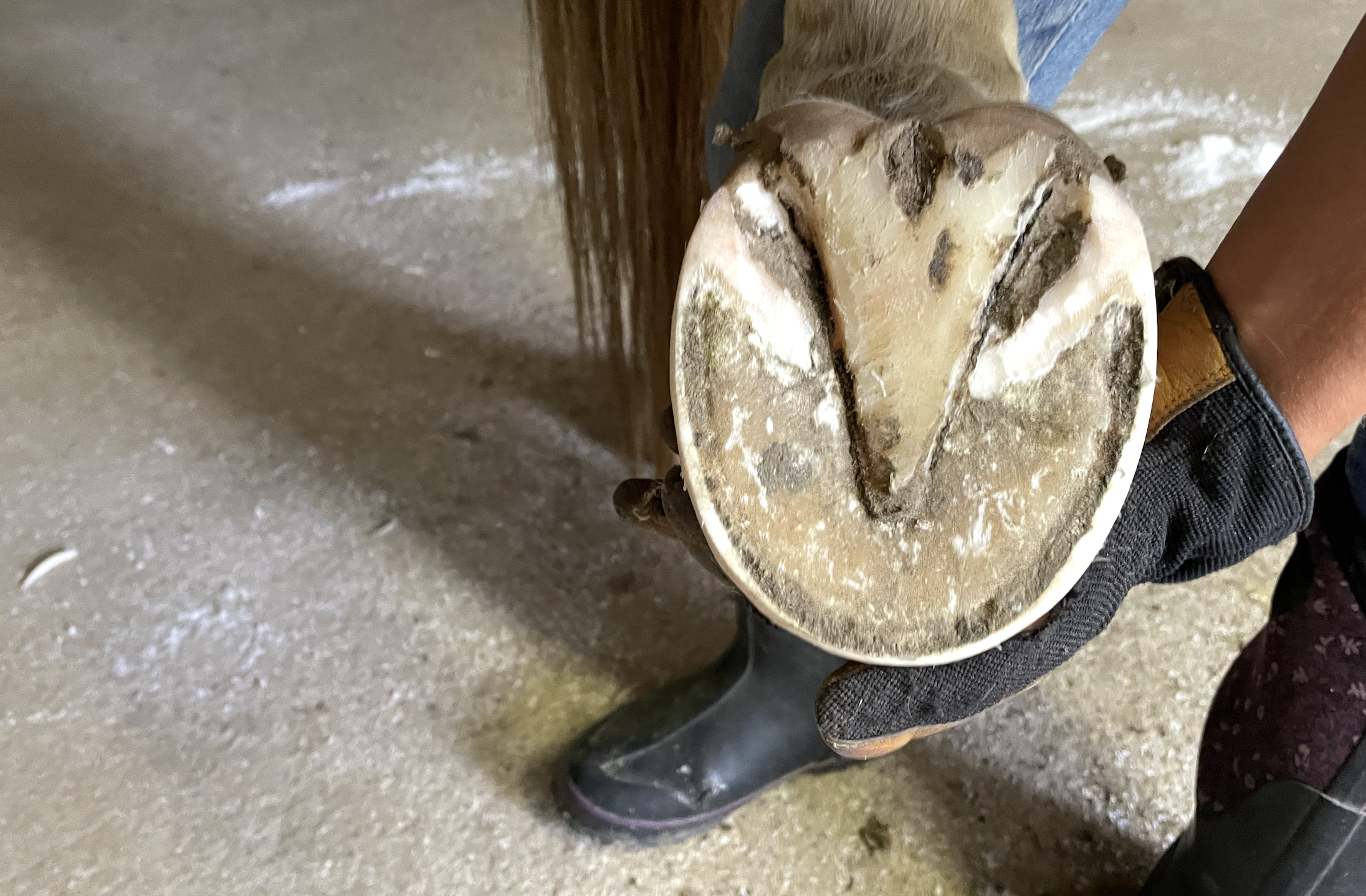
It’s hard to know if your farrier is doing a good job, prior to a catastrophic outcome, if you don’t know what a healthy hoof looks like and how it relates to the horse’s overall anatomy, movement and health. Unfortunately, your farrier may not be the best resource when leaning this info because if they aren’t doing a good job, they aren’t going to tell you that. I often encourage people to crowd-source; asking their farrier, other farriers, their vet, other long-time and knowledgeable horse owners, and various sources online. You should spend time looking at the hooves of the horses in your barn and matching what you see up with what you are learning. A refrain I often hear is “I LOVE my farrier, I’m sure they are doing a good job.” Unfortunately, there are a lot of nice, lovely people out there who trim but for one reason of another (lack of education, lack of talent, laziness) aren’t doing a competent job.
Some basics to investigate include:
- Hoof anatomy
- Pastern/hoof angle relationship
- Coffin bone and the palmer angle
- Flare
- White line separation
Preparing your horse.

It is our job, as horse owners, to ensure our horses are well-versed in having their feet handled and can maintain a relaxed and calm emotional state during the process (assuming they are being handled in a competent manner). Farrier work is hard enough even with a calm, well-behaved horse and I can’t blame farriers for being grumpy about horses that are challenging to handle – sometimes putting the farrier’s safety at risk.
Similar to what I’ve said, regarding loose rains and loose lead ropes, my goal is to have my horses willing to give full control over to the person handling their feet without any restraint. In this video, you can see that Huey is able to hold himself where he needs to be by letting me manipulate his feet. This isn’t an exercise in ground tying. Huey does not know how to ground tie. But he understands from the feel I’ve provided that he needs to stay here while I trim his feet. When not doing this for a demonstration video, I typically do have my lead rope looped around one of the posts in the barn aisle to help him understand where he needs to stay put.
I practice this with almost every horse that comes in for training – asking the horse to give me full control of the placement of their feet. Even if trimming isn’t something, the owner has specifically indicated needs improvement. Even a particularly troubled horse, named Noodle, for those of you who are familiar, was successful at having his hooves trimmed in this manner – loose lead rope while giving me full control of his feet..
Making sure your farrier reinforces your preparation.

All your preparation will be for naught if your farrier is rough or ill-tempered with your horse. I’ve solved “training issues” by simply having clients switch to a different farrier. One of the most challenging things I’ve encountered is getting farriers to put the horse’s feet down, rather than drop them. You can’t really blame a horse for learning to grab their hooves back, or else risk having them dropped onto concrete (sometimes with metal shoes on).
Video of me pretending to trim Huey – showing that he is relaxed and knows the job well enough to do it without restraint – although he’d really like to check out that container of swat.
Leave a Reply