

Like most people, I learned to ride with a “straight line in the rein from the bit to the rider’s hand”. The idea was to be in communication with the horse at all times. At various times, I would take lessons from jumping instructors or dressage instructors who encouraged me to continuously shorten that contact and drive the horse forward so that I maintained multiple pounds of weight in each rein. My arms would be tired and my legs would be tired by the end of the lessons from trying to maintain this constant push/pull. Many people come to me with a similar foundation and it is one of the things I have them change right from the start.
Yes, the reins are absolutely there to help provide communication and connection with the horse. And in fact, they are one of the primary ways I communicate with my horse under saddle. But many people I meet are not nearly balanced enough walk, trot, canter, through transitions, tight turns, etc. to maintain any semblance of intentional, soft communication on the reins. I know this because as soon as I take away their short contact and have them ride on the buckle, they quickly figure out how much they have been using those reins for security and to help them balance. How could your balance not be affected by holding onto something tightly? I think most people would agree that using your horse’s mouth to balance while riding is unfair.

Another reason I have people loosen their reins, is it helps them stop fixating on their horse’s head position. There are so many other more important things to work on, yet many people spend the majority of their time trying to wrestle, pull or seesaw their horse’s head down into some semblance of “vertical”. The number of pictures I see people proudly post of tense, crooked, frustrated horses with their heads cranked “into position” shows me that there is a serious over-fixation on this piece of biomechanics that will largely happen naturally when attention is paid to the rest of the picture.

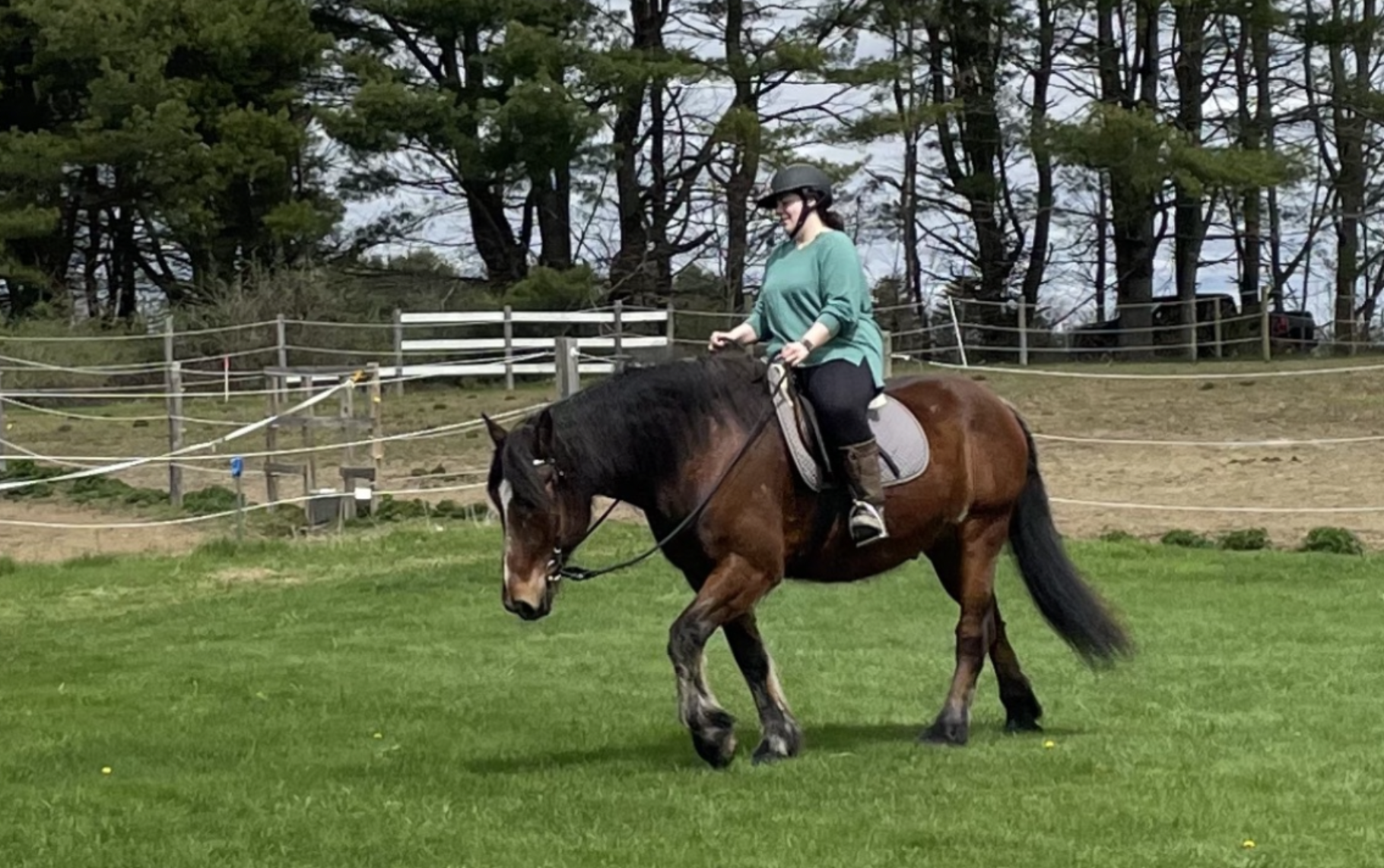
Managing worry is a subject that deserves a post of its own. The reins are often a tool used to keep a worried horse physically under control, rather than fixing the worry, and maintaining control due the horse’s relaxed emotional state. Releasing those reins can really bring this issue out into the open. I often tell my students that “if you can’t do it on a loose rein, you can’t really do it.” This is something I really started to understand with my pony, Huey. For years, we would gallop through fields, sprint over jumps and do all sorts of things. But if I’d try to do those things on a loose rein, he’d simply run off with me, likely throwing a few bucks. The anxiety was there regardless of my rein length, but letting my reins out really exposed it and helped me understand we had work to do.
The last thing I’ll mention harkens back to something I wrote at the beginning of this post. “My arms would be tired and my legs would be tired by the end of the lessons from trying to maintain this constant push/pull.” This type of constant pressure is the antithesis of how horses function. Horses are always seeking comfort and total relief. When they can’t find it, they shut down, become confused, agitated, explode or some other undesirable outcome. There cannot be any clarity about the meaning of the legs or reins if both are being applied at the same time, in contradictory ways – “Go forward, no don’t go forward, no go forward, no don’t go forward. Gosh darn it, why are you so dull!”. Not to mention the physical discomfort of someone constantly squeezing your ribcage, and/or pulling a hard surface against your gums, cheeks, or the roof of your mouth.

For me, one of the most impactful experiences has been riding horses that have been handled right from the start with immense clarity by horsemen who have a lot of feel. Once I could feel the emotional calm, the relaxation and the way a horse could be so light and soft (and moving bio-mechanically correct!) on a very loose rein, it gave me a concept of the way things could be. It’s hard to know any different when you’ve never felt something different. It’s hard to achieve this without many, many, many, many hours in the saddle – mastering your own emotional, physical and mental regulation. This fixation on a horse’s head position and maintaining tight contact is one of the things most in the way of achieving the true soft connection many of us are seeking with our horses.
Examples of myself and students working at speed on a loose rein.
Leave a Reply