I get asked this question a lot. It’s a great question that really prompted me to contemplate and differentiate the two in my own mind.
If you think about the request to ask a horse to go, from their back, typically a rider will use their leg in some capacity to communicate the request. The mechanical application of leg pressure is a cue. The quality of the leg pressure is feel (speed of application, amount of pressure, timing, etc).

I would argue that I’ve taught my horses very few cues. The main ones are to follow a feel and to move away from pressure. Once they understand those concepts, I can apply them in innumerable qualities and combinations to get most everything that I need to done. Because horses use pressure to communication with each other, it usually takes very little to get these two things working. At that point, the success of ground interactions and riding become far more about feel.
Cues are fairly easy for humans to understand and apply. Feel is far more challenging. It takes time, repetition and experimentation to learn the intricacies of good feel. Horses have a concept of feel intrinsically and we humans tend to be severely lacking. Feel is what I spend 95% of my time working on personally. And it’s what I spend 95% of my time teaching.
More generally, a cue is an independent action hoping to illicit an independent reaction. For example, the action of tapping a whip in the air to cue a rear. Or slapping your hand at your side for your horse to line up to the mounting block. Without the use of nuanced feel, a cue doesn’t tell the horse anything about the quality of response you would like. If you pull on the reins to stop, do you want the horse to slide to a stop, or slowly decrease speed? Should they stay straight or stop on a curve? Should they respond immediately or 3 seconds from now?

A main reason that I focus on feel, is that it encapsulates all the little moments in between cues. For example, you can carry a feel between yourself and your horse the entire time the two of you are traveling in-hand or under saddle together. There is a feel of going together. There is a feel as you prepare to apply a cue, and if you get good at communication with your horse via feel, you will realize that your intent, presence and energy have as much to do with communication as any manual, overt signal.
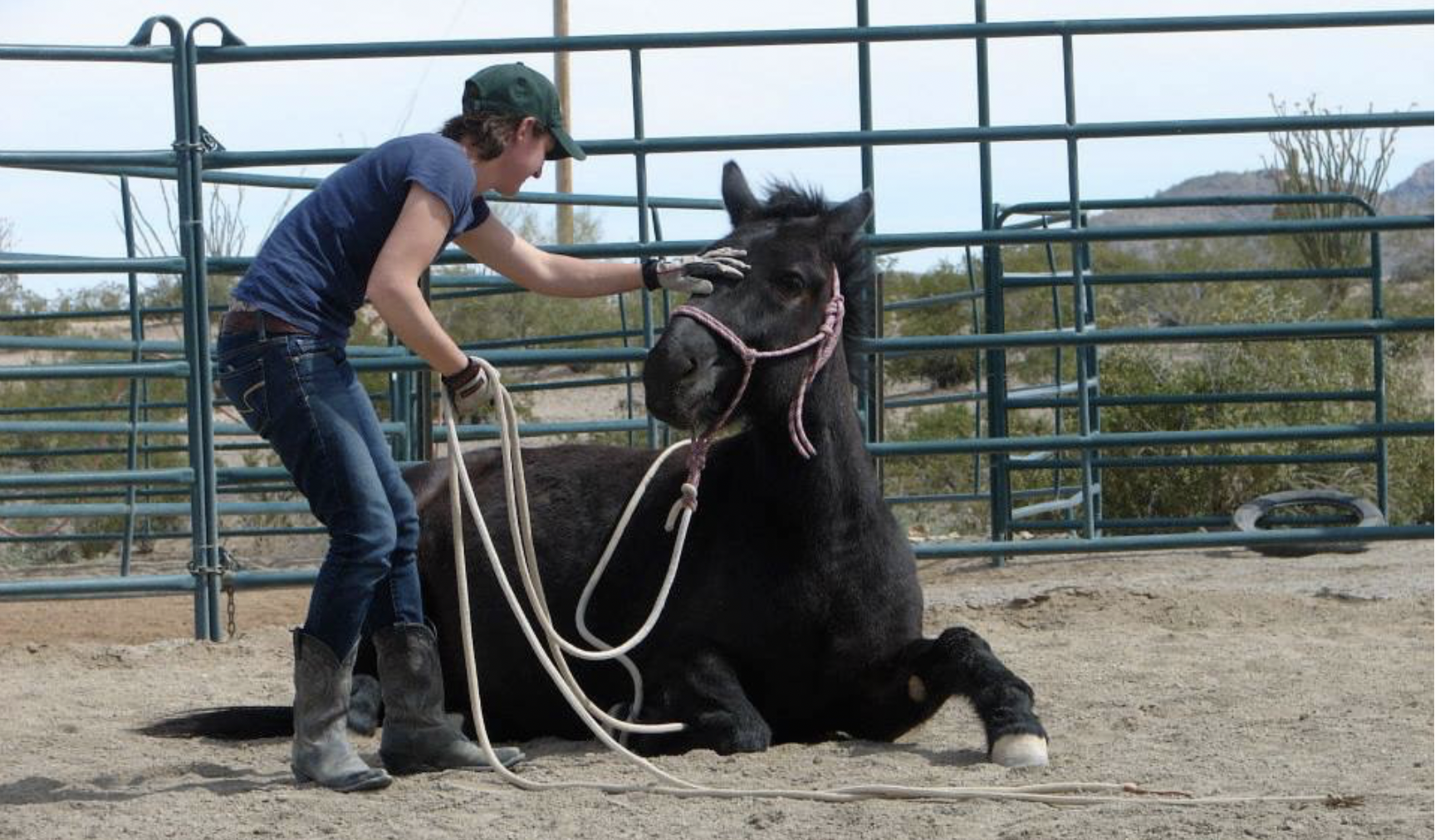
I learned to ask a horse to bow and lay down using a feel-based system years ago. I ask the horse to shift their weight, lower their front end, shift their weight to the side, lower their hip and ease their way down to the ground. If it’s going well and I’m applying a little pressure just right and releasing just right, the horse isn’t stressed – the horse and I have been in communication throughout the whole process.


Due to my current physical limitations, I’ve been experimenting with a cue and treat based system to ask my horses to lay down. It’s working. It’s been a longer process, though speed isn’t everything. And I’m not going to lie, I’ve found it largely dissatisfying. A small amount of feel does come into play, but I don’t actually feel very connected to my horse. I give a physical signal and they take their sweet time laying down and then stare at me expectantly for a treat. Sometimes they lay down in 30 seconds. Sometimes it takes 5 minutes. Sometimes they lay down near where I asked. Other times they completely change direction and end up 30 feet away.

Asking a horse to lay down via a cue is a fun little trick and I’m thankful to be expanding my repertoire. I’m not finding it as rewarding as a feel-based system but it’s great to know multiple ways to approach a problem (or skin a cat… but that’s a terrible saying!).